 中文
中文


.png) Search
Search


 > Home>Contact Us>Latest News> Extruded, Skived or Zipper Fin Heat Sinks, Which One is the Best for You?
 Return to List
Extruded, Skived or Zipper Fin Heat Sinks, Which One is the Best for You?
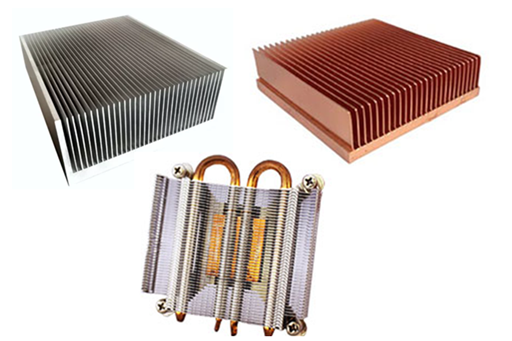
As power densities continue to increase in electronics, thermal management has become a critical design consideration. Selecting the right heat sink technology can significantly impact system performance, reliability, size, and cost.
Let’s look at the differences between these heat sink technologies and provide guidance on where each solution performs best.
Extruded Heat Sinks
Extruded heat sinks are manufactured by forcing heated aluminum through a shaped die, creating a continuous profile that can be cut to desired lengths. This process produces an integral structure where the base and fins are formed from a single piece of material.
Advantages
Lowest manufacturing cost for medium-to-high volume production
Excellent mechanical strength due to one-piece construction
Wide availability and short lead times
Lightweight and corrosion-resistant
Suitable for many general-purpose cooling applications
Limitations
Fin height and fin density are limited by extrusion tooling constraints
Typically manufactured from aluminum alloys only
Lower thermal performance compared to advanced fin technologies
Less effective in high-power or space-constrained designs
Best Applications for Extruded Heat Sinks include:
Industrial controls
Power supplies
LED lighting systems
Telecommunications equipment
Consumer electronics
Moderate-power electronics with natural or forced-air cooling
When cost, simplicity, and manufacturability are primary concerns, extruded heat sinks often provide the best overall value.
Skived Fin Heat Sinks
Skived heat sinks are produced by slicing thin layers of material from a solid metal block and bending them upward to form fins. Because the fins remain attached to the base material, the resulting structure maintains excellent thermal conductivity.
Both aluminum and copper can be used, with copper skived heat sinks offering particularly high thermal performance.
Advantages
Higher fin density than extrusion
Taller, thinner fins improve heat transfer
No thermal interface between fins and base
Excellent thermal conductivity
Can be manufactured from copper for demanding applications
Limitations
Higher manufacturing cost than extrusions
More complex fabrication process
Practical limits on fin geometry still exist
Heavier when copper is used
Applications that Skived heat sinks excel in:
High-performance computing
CPUs and GPUs
Networking equipment
Power conversion systems
Medical electronics
Aerospace and defense electronics
Designers often select skived heat sinks when thermal performance requirements exceed the capabilities of traditional extrusions but a bonded-fin assembly is unnecessary.
Zipper Fin Heat Sinks
Zipper fin heat sinks use individually stamped metal fins that are mechanically interlocked into grooves in a base plate. The fins resemble the teeth of a zipper, giving the technology its name. This manufacturing approach allows extremely high fin densities and flexible fin geometries that are difficult or impossible to achieve through extrusion or skiving.
Advantages
Extremely high fin density
Excellent airflow utilization
Can be integrated with heat pipes
Flexible fin shapes and configurations
Available in aluminum, copper, or mixed-material designs
Ideal for forced-air cooling applications
Supports large cooling surface areas in compact footprints
Limitations
Higher manufacturing complexity
More expensive than standard extrusions
Thermal resistance at fin-to-base interfaces can be slightly higher than monolithic designs
Typically optimized for systems with active airflow
Zipper fin heat sinks are commonly used in:
Data center servers
AI and HPC systems
Telecom infrastructure
Base stations
Enterprise networking equipment
High-power FPGA and ASIC applications
Whenever maximum cooling performance is required in a constrained space with forced airflow available, zipper fin heat sinks are often the preferred solution.
Summary
No single heat sink technology can provide every electronic cooling solution. Extruded heat sinks remain the most economical solution for many designs, while skived heat sinks offer improved thermal performance through higher fin densities and superior material options. For the most demanding thermal challenges, zipper fin heat sinks provide exceptional cooling capability and design flexibility.
Ultimately, the ideal heat sink is one that satisfies thermal requirements while meeting mechanical, manufacturing, and economic objectives. By carefully evaluating airflow, thermal load, space constraints, materials, and cost, engineers can select the most effective thermal management solution for their specific application.