 中文
中文


.png) Search
Search


 > Home>Contact Us>Latest News> Tubed Cold Plates: Balancing Thermal Performance, Reliability, and Cost
 Return to List
Tubed Cold Plates: Balancing Thermal Performance, Reliability, and Cost
Tubed cold plates provide a reliable, cost-effective liquid cooling solution when air cooling can no longer dissipate the required heat load. They typically consist of an aluminum plate with embedded copper or stainless-steel tubing. Heat-generating electronic components are mounted directly to the plate, allowing heat to conduct into the tubing where a circulating coolant—typically water or a water-glycol mixture—absorbs it. The heated coolant then flows to a heat exchanger or chiller before returning to the cold plate to repeat the cycle.
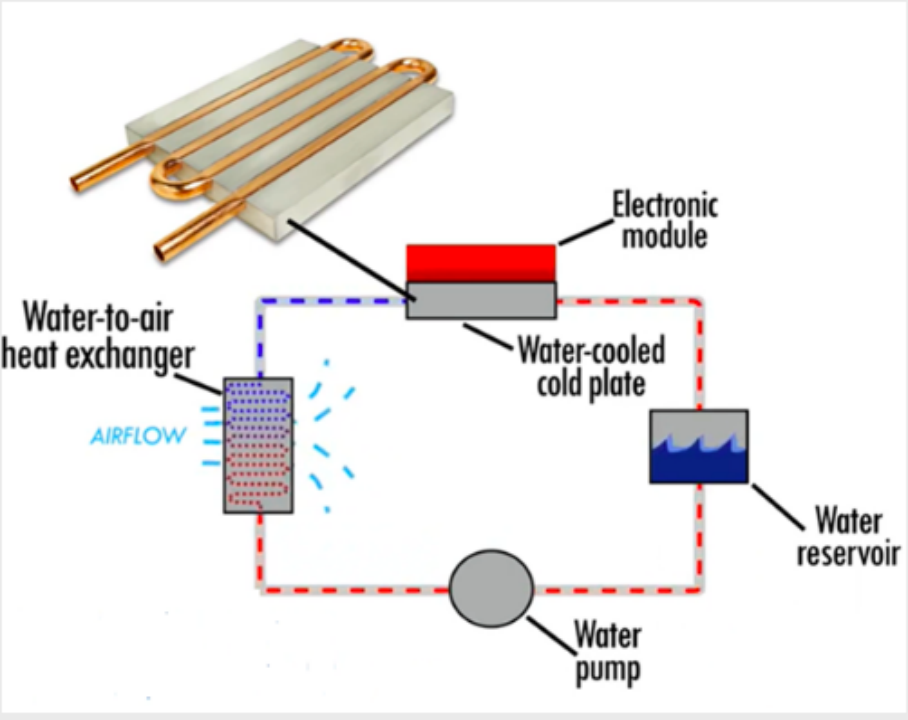
Fig 1 – A Tubed Cold Plate Requires a Complete Liquid Loop to Function. Other Loop Components Include a Liquid Reservoir, a Pump, and a Heat Exchanger.
As with most liquid cooling systems, increasing coolant flow rate reduces the thermal resistance between the electronic components and the coolant, improving overall heat transfer performance. For example, with coolant flowing at 1.9 LPM (liters per minutes) one copper-tube cold plate provides thermal resistance of 0.013°C/W. When the flow rate increases to 7.6 LPM, the resistance drops to 0.007°C/W. Continuous copper and steel tubing readily manages high flow rates.
Thermal performance depends on several design variables, including tube material (typically copper or stainless steel), the tube attachment method, and the coolant flow path. Together, these factors determine whether a tubed cold plate is appropriate for the required heat load, coolant chemistry, and operating pressure.
Embedding the Tube
The tube is continuous, without joints, which eliminates leak threats and allows it to be bent into serpentine patterns to optimize the plate’s performance.
The method used to attach the tubing to the cold plate has a significant influence on thermal performance.
Pressed-In (Epoxy Mounted): The tube is pressed into pre-machined grooves on the plate and secured with a thermally conductive epoxy. This is cost-effective but introduces a slight thermal barrier.
Direct Contact: The embedded tube is machined flat so it sits perfectly flush with the plate surface. The electronic component touches the tube directly, maximizing heat transfer.
Soldered/Brazed: The tube is metallurgically bonded to the plate. This offers the best thermal performance for tubed designs but increases manufacturing costs.
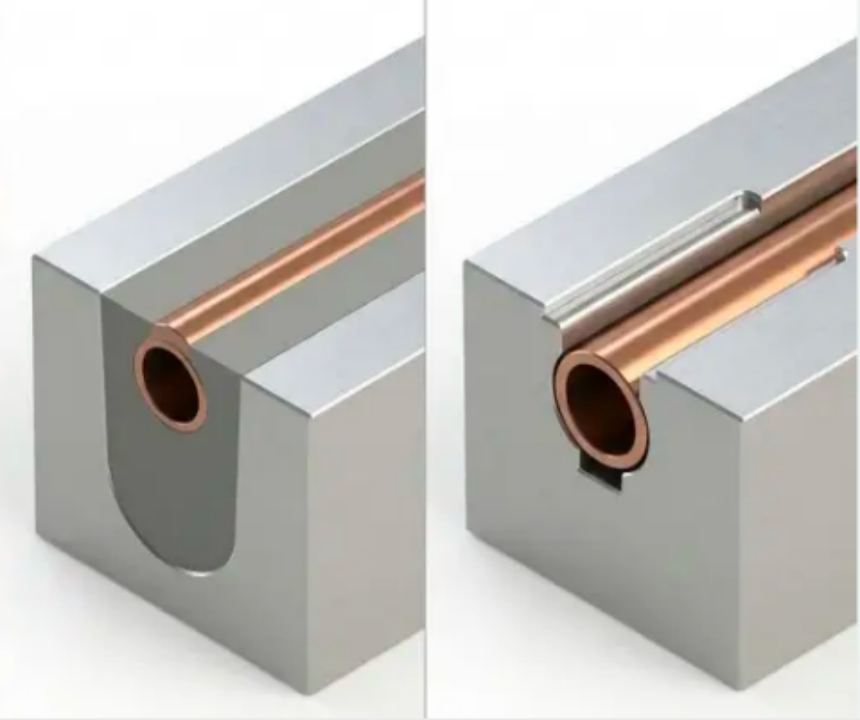
Fig 2 – (Left) Copper Tube Embedded in Thermally Conductive Epoxy. The Epoxy Improves Heat Transfer to the Aluminum Plate and Keeps Out Potential Insulators, (Right) Press-Fit Copper Tube Provides Secure, Continuous Direct Contact with the Plate.
Tubed Cold Plate – Application Example
Tubed cold plates provide cooling to components with low to moderate heat loads. They are used in thousands of commercial, industrial and military electronics devices. Industry standards for tubing and connectors, and relatively simple construction, provide the flexibility to fit many applications.One example is an ultra-wideband radar subarray consisting of clustered amplifier and analog electronics operating across ambient temperatures ranging from –18°C to 46°C. Air cooling was initially evaluated, but the required heat sink length and high system airflow pressure made that approach impractical. A liquid-cooled tubed cold plate provided the required thermal performance while meeting system constraints.
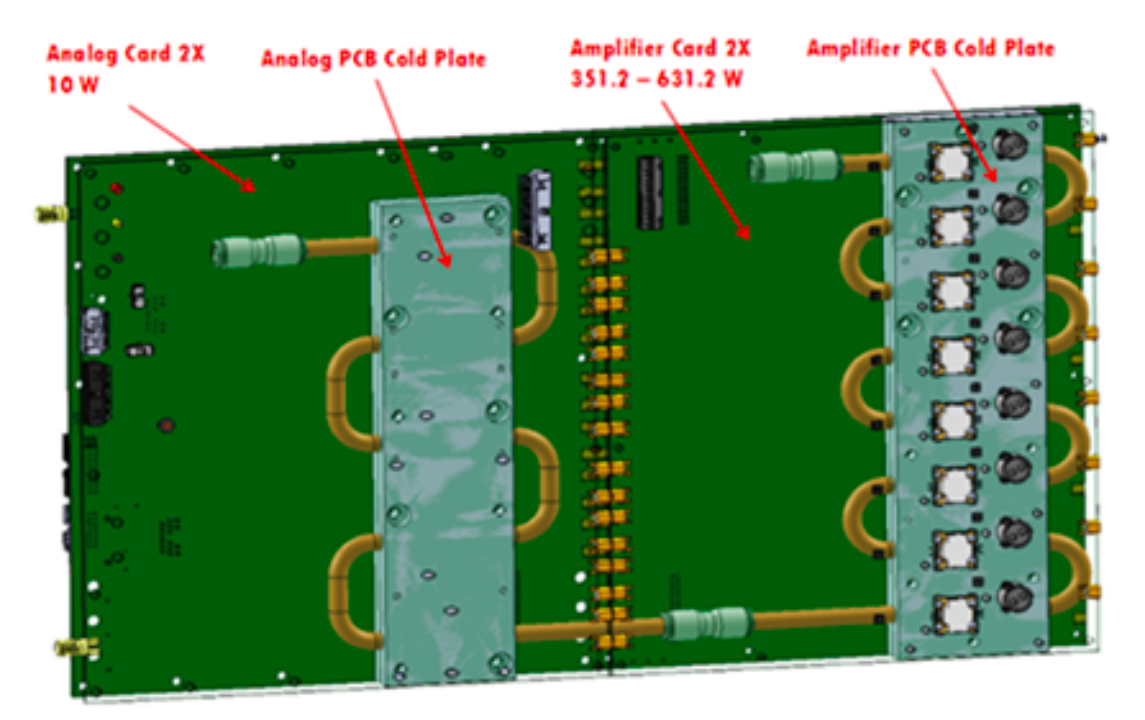
Fig 3 – (Top) Conjoined Cold Plates Cool the Analog and Amplifier Board Sections on Radar Device. Added Tube Turns Optimize Cooling of the Hotter Amplifier Components. (Bottom) CFD Model with 75W Power in the Amplified and a 12 GPM Flow Rate Showed Achievement of Target Cooling Performance.
ATS developed dual tubed cold plates for the amplifier and analog assemblies using standard 0.25-inch (6.35 mm OD) tubing arranged in a multi-pass serpentine configuration. The geometry was optimized to balance heat transfer, pressure drop, and manufacturability. The cold plates were modeled in series with push-to-connect manifold integration. Because of the resulting hydraulic resistance, a higher-capacity pump was required to achieve the desired coolant flow rate. [19]
This tubed cold plate application used thermal engineering methods that integrated CFD and system-level flow modeling, including pump curve interaction. Both thermal and hydraulic performance were optimized, Standard tube and cold plate geometries were used, enabling rapid, lower cost production and scalability.
More Tube Turns Increase Heat Transfer
Increasing the number of tube passes generally improves heat transfer by increasing the tubing surface area available for conduction and by distributing coolant beneath a larger portion of the plate. The result is lower peak temperatures and improved temperature uniformity across the mounting surface.
But there is a limit to the benefits from added tube turns. While they capture more heat, a high number of turns increases fluid friction and hydraulic resistance (pressure drop) inside the cold plate. As with the example above, a more powerful pump may be needed.
Another issue is the rise in coolant temperature. As it travels through a complex pathway in the cold plate it will absorb so much heat that it can’t absorb more. Because the fluid is now warm, those extra turns at the end of the loop transfer heat much less efficiently than the first few turns.
Summary
Tubed cold plates remain one of the most widely used liquid cooling technologies because they combine proven reliability, relatively low manufacturing cost, and robust mechanical performance. Their continuous tubing construction minimizes leak paths while allowing operation at higher coolant pressures than many alternative cold plate designs.
Because they use continuous tubing, they have zero internal joints, making them highly reliable for sensitive electronics.
There are material choices to fit different applications. For example, you can use an affordable aluminum plate for structure, but a copper tube inside to handle corrosive water coolants without galvanic corrosion.
They are generally much cheaper to manufacture than vacuum-brazed or micro-channel cold plates. And the inherent strength of metal tubing allows these plates to handle high fluid pressures.
Are there limitations? Yes.
There are limits on how tightly a metal tube can be bent without crimping or restricting fluid flow.
More tube passes can improve heat transfer and temperature uniformity, but too many passes increase pressure drop and reduce efficiency as the coolant warms.
Also, cold plates have higher thermal resistance than vacuum-brazed or micro-channel cold plates because the heat must travel through the plate-to-tube interface.